

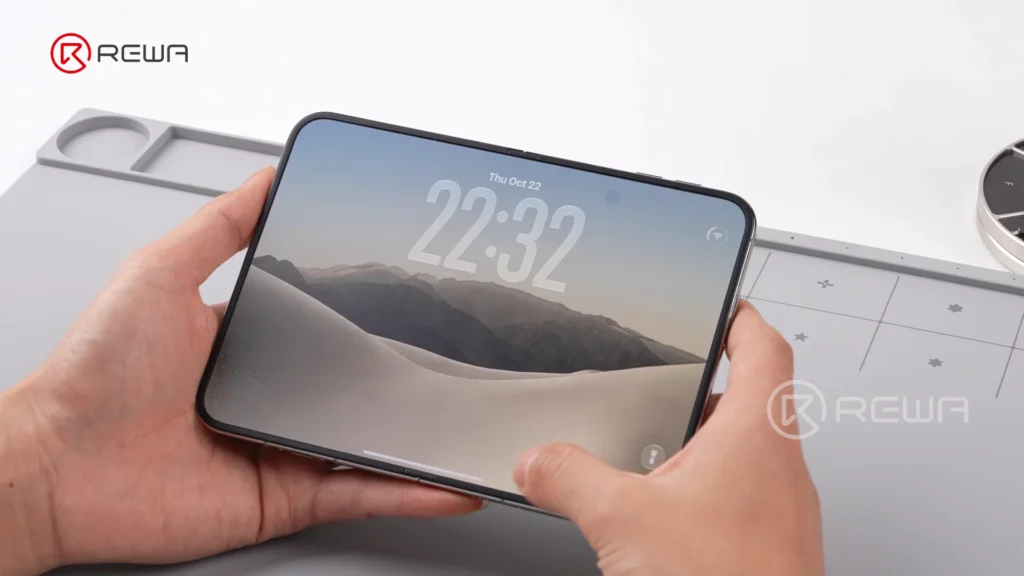
Apple’s first foldable iPhone, the iPhone Duo, introduces a new set of challenges for smartphone repair technicians. With two displays, multiple hinge flex cables, a complex antenna layout, and a mechanical folding hinge, does its innovative design make repairs twice as difficult?
In this REWA Lab teardown, we disassemble the iPhone Duo to examine its internal structure and identify the components that could make repairs easier—or more complicated. Whether you’re a professional technician, a refurbishment business, or anyone who is interested in Apple’s first foldable iPhone, here’s what you need to know.
iPhone Duo at a Glance
The iPhone Duo combines a foldable inner display with an outer display in a compact chassis. Understanding its dimensions and screen construction provides a useful starting point for evaluating its repairability.
Key specifications observed during the teardown:
| Dimensions | REWA Lab Findings |
| Poids | 254.2 g |
| Thickness when unfolded | 5.20 mm |
| Thickness when folded | 11.23 mm |
| Outer display | 5.4-inch D-shaped display with delicate flex cable near the lower-right corner |
| Inner display | Heavy adhesive and metal-welded bracket attachment points |
| Front cameras | Under-display cameras on both displays |
| Battery capacity | 4883 mAh combined (2962 + 1921mAh) |
| Hinge mechanism | Four sets of springs |
The crease is more noticeable when the inner display is turned off and less noticeable when the screen is illuminated. This demonstrates how the crease can affect the visual appearance of a foldable display, although its visibility alone does not determine the panel’s condition.
Double Displays: Two Screens, Two Different Repair Challenges
The iPhone Duo’s two-display design introduces distinct challenges because the outer and inner displays use different mounting structures and removal methods. For repair businesses, understanding these differences is essential when estimating labor, replacement-part costs, and the risk of accidental damage.
Outer Display: Watch Out for the Display Flex Cable
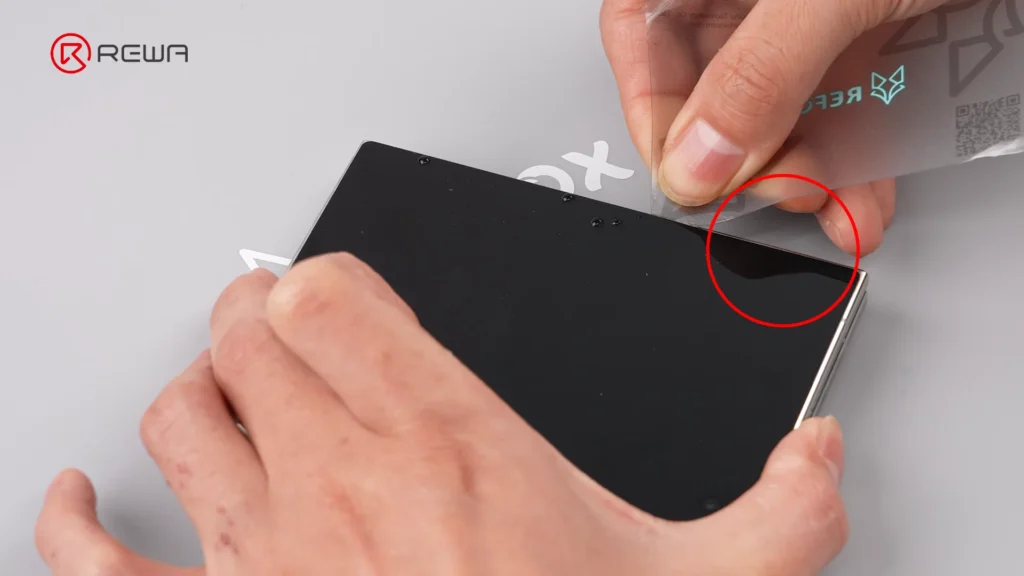
The 5.4-inch outer display is secured with adhesive around its perimeter. During removal, technicians must soften the adhesive and carefully separate the panel from the frame.
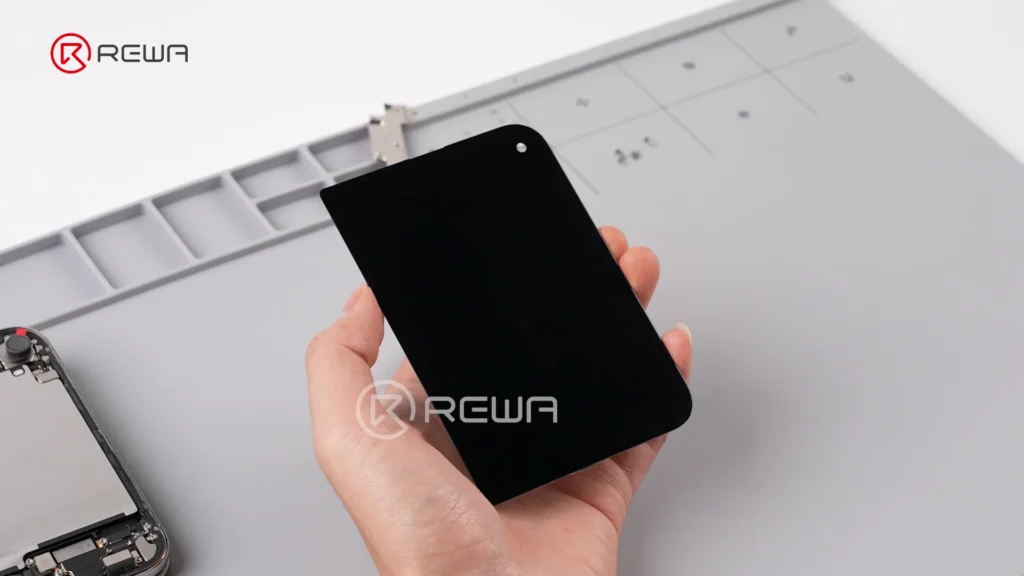
One critical detail is the outer display flex cable near the lower-right corner. An incorrectly positioned blade or excessive prying force could damage this cable and turn a screen replacement into a more complicated repair.
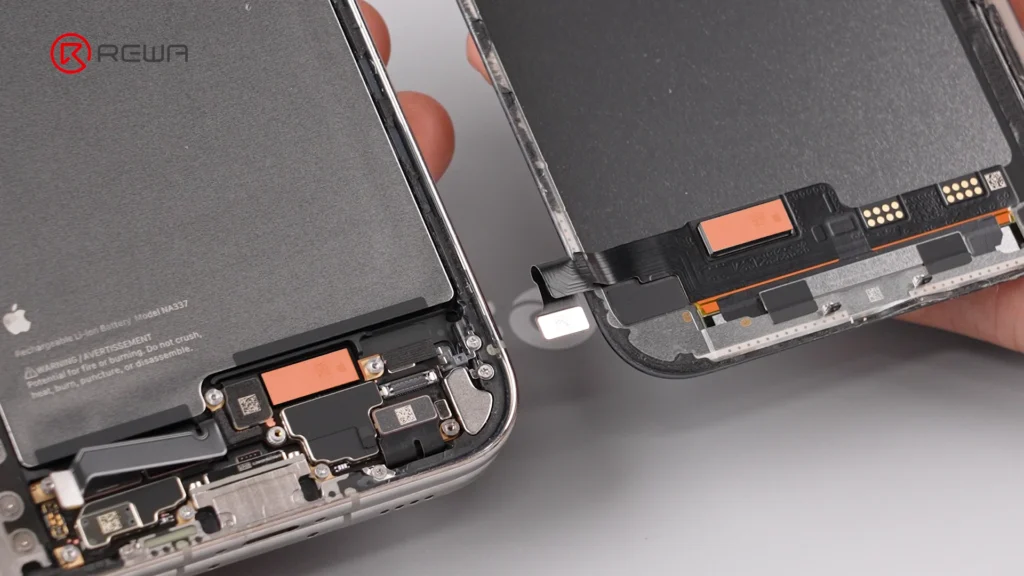
The outer display also features two display ICs positioned back-to-back. This compact arrangement could contribute to localized heat buildup, although thermal testing would be required to establish its actual operating temperature.
Pro Tip: Control your blade depth and insertion angle when separating the outer display.
If you encounter unexpected resistance, apply more suitable adhesive-softening liquid and allow it to work rather than forcing the tool through the bond.
Inner Display: Heavy Adhesive and a Metal-Welded Bracket
The inner display presents a different challenge. It is secured with a substantial amount of adhesive, and its display bracket has attachment points that are metal-welded to the frame.
This construction makes removal more demanding than simply cutting through the adhesive around the screen. Technicians must also account for the bracket’s attachment points and the risk of damaging the delicate foldable panel during separation.
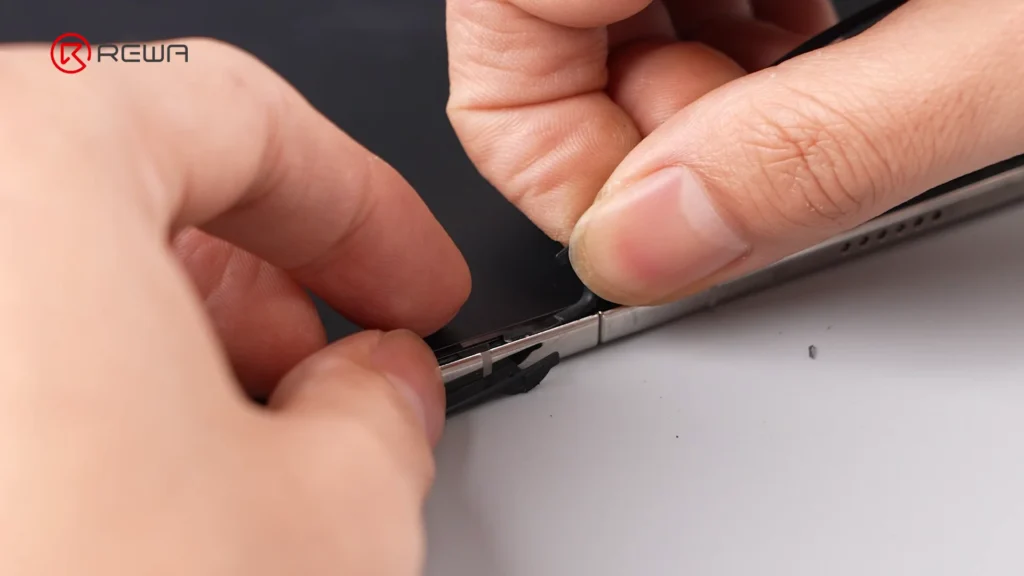
Pro Tip: Treat the inner display as a high-risk component.
Work gradually around the perimeter, soften the adhesive repeatedly, and avoid applying concentrated pressure to the folding area.
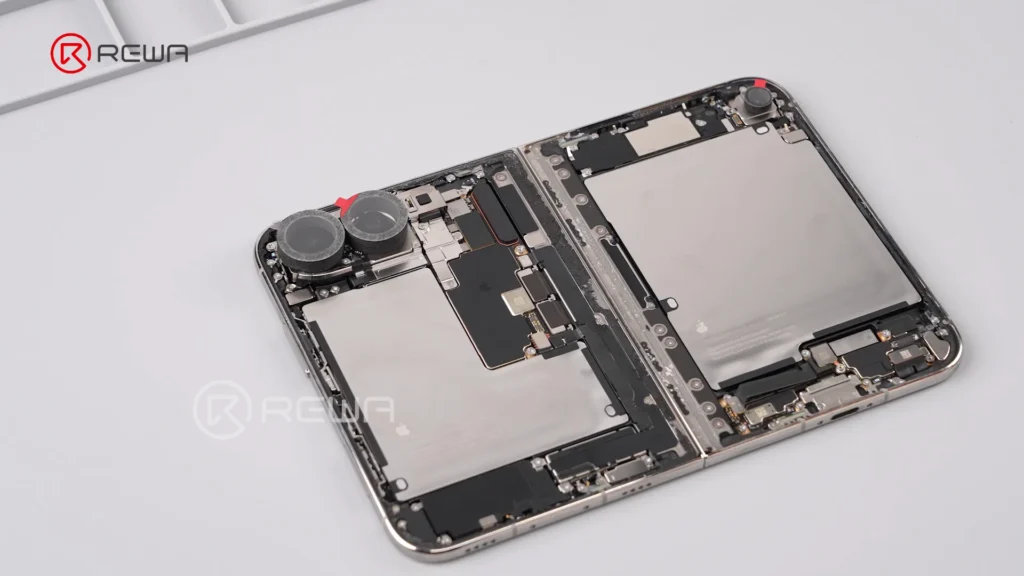
iPhone Duo Internal Layout: Batteries, Cameras, and Antennas
The internal layout of the iPhone Duo reveals how much engineering is required to accommodate its dual displays and folding mechanism. Several components overlap or sit close together, making the order of disassembly especially important.
Two Batteries Occupy Much of the Internal Space
The iPhone Duo uses two steel-cased batteries: one larger and one smaller. Together, they occupy approximately 60–70% of the internal space observed in the teardown and have a combined rated capacity of 4,883 mAh.
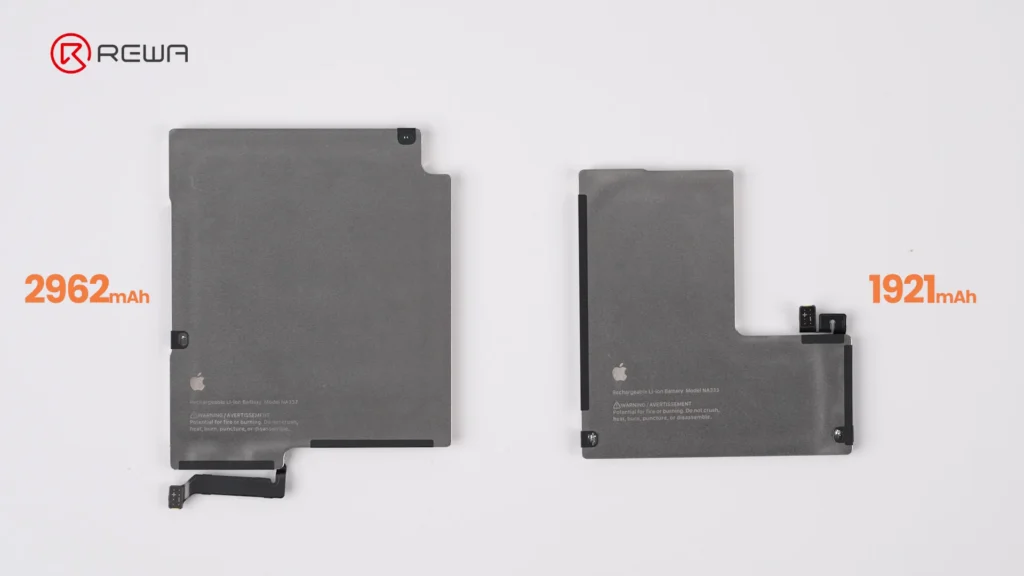
Both batteries contain hollow areas within their structures. Their placement and form factor reflect the space constraints imposed by the foldable design.
For repair technicians, the two-battery configuration means that battery servicing requires attention to both battery assemblies and their adhesive systems. Like iPhone 18 Pro, releasing the battery adhesive also required low electrical current to be applied.
Pro Tip: Disconnect the battery before proceeding with other internal repairs whenever the design and service procedure permit.
Front Cameras: Two Modules, Different Cable Designs
The iPhone Duo features a under-display front camera. The outer display’s front camera has a notably shorter flex cable and is remarkably thinner than the inner display’s front camera.
These differences matter during repair because thin flex cables can be vulnerable to tearing, creasing, or accidental pulling. Technicians should also pay attention to the front protective covers and connector brackets during removal and reinstallation.
Rear Cameras and Antennas: Disassembly Order Matters
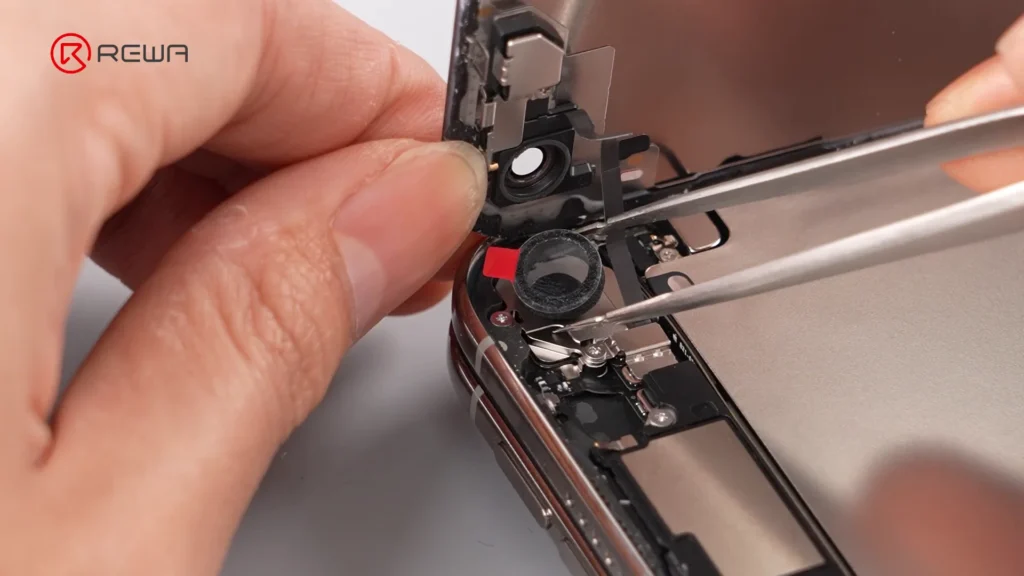
The rear camera assembly is more complicated to remove because an antenna wraps around the cameras and overlaps their flex cables.
The antenna must be moved out of the way before the rear cameras can be safely removed. Attempting to pull the camera assembly out prematurely could place unnecessary stress on the cables or antenna components.
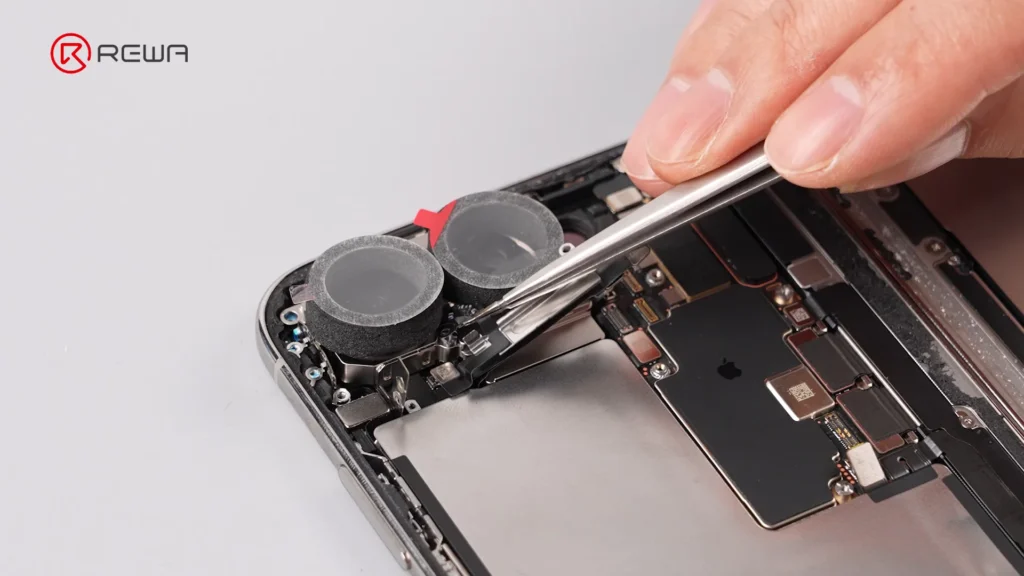
Pro Tip: Map overlapping components before removing them.
If an antenna, bracket, or cable crosses another component’s removal path, identify the correct disassembly order first. This is particularly important in compact foldable devices, where components are tightly integrated.
Motherboard Design: A Potential Advantage for Repairability
Not every aspect of the iPhone Duo’s internal design makes repairs more difficult. One notable change is its motherboard architecture, which may simplify certain repair operations compared with a traditional sandwich-style design.
A Split Logic Board and Sub-Board
The iPhone Duo uses a separate logic board and sub-board connected by a flexible printed circuit (FPC). The sub-board connects to both displays and also accommodates other connections, including the charging port flex cable and hinge-related flex cables.
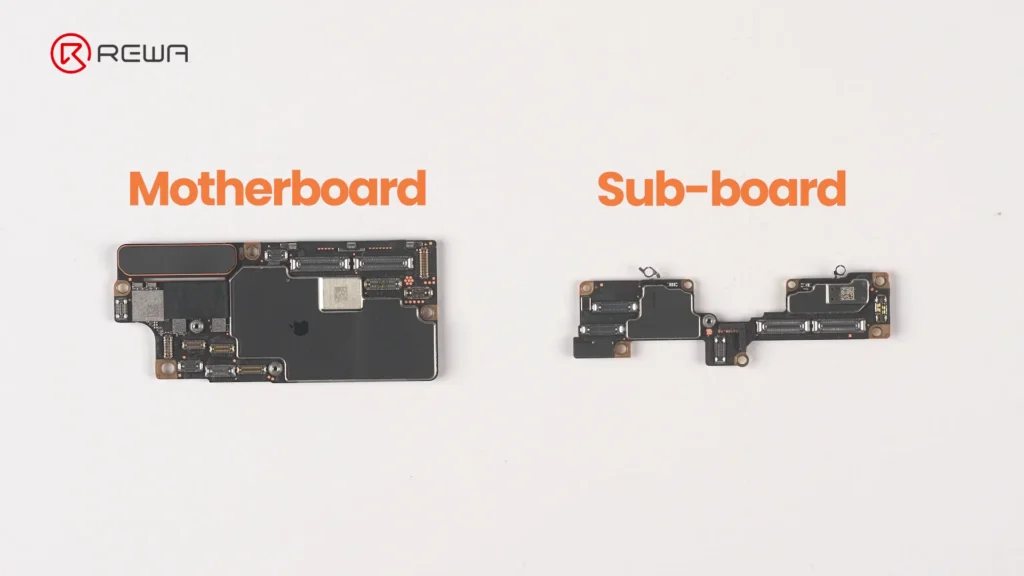
This separation could make some board-level repairs more manageable because technicians can work with distinct board assemblies rather than performing a risky motherboard separation.
Storage Upgrade Potential
The NAND storage chip is located next to the A20 Pro chip on the logic board. This layout may benefit technicians performing storage upgrades, as the storage chip is mounted directly on the logic board, allowing for easier access during repair.
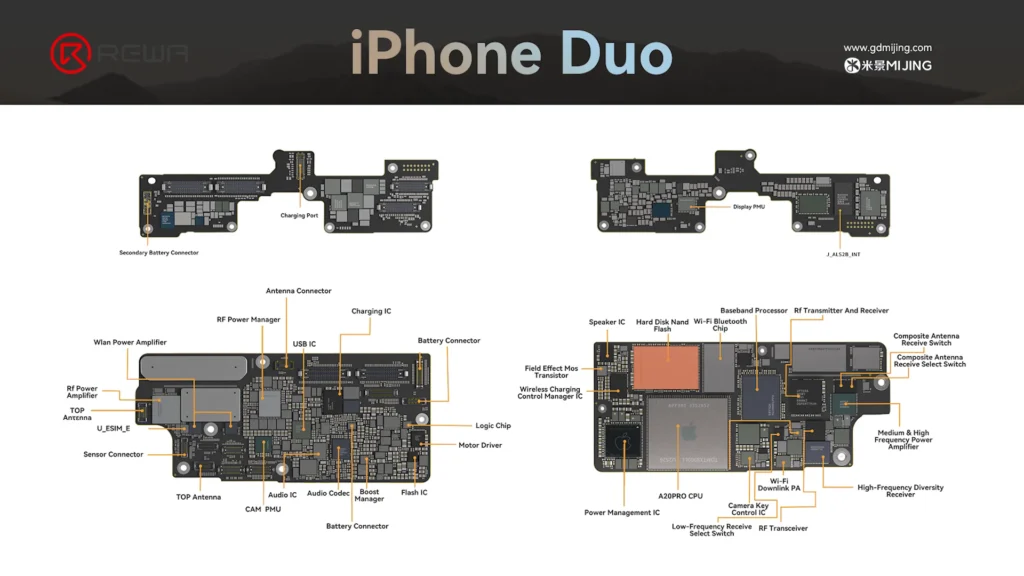
However, physical proximity alone does not guarantee that a storage upgrade is straightforward. Compatibility, firmware, programming requirements, and device-level restrictions must also be considered during operation.
Other Internal Design Details
Only the logic board side has a vapor chamber, while the other side has an aluminum alloy plate. The vapor chamber helps distribute heat away from heat-generating components.
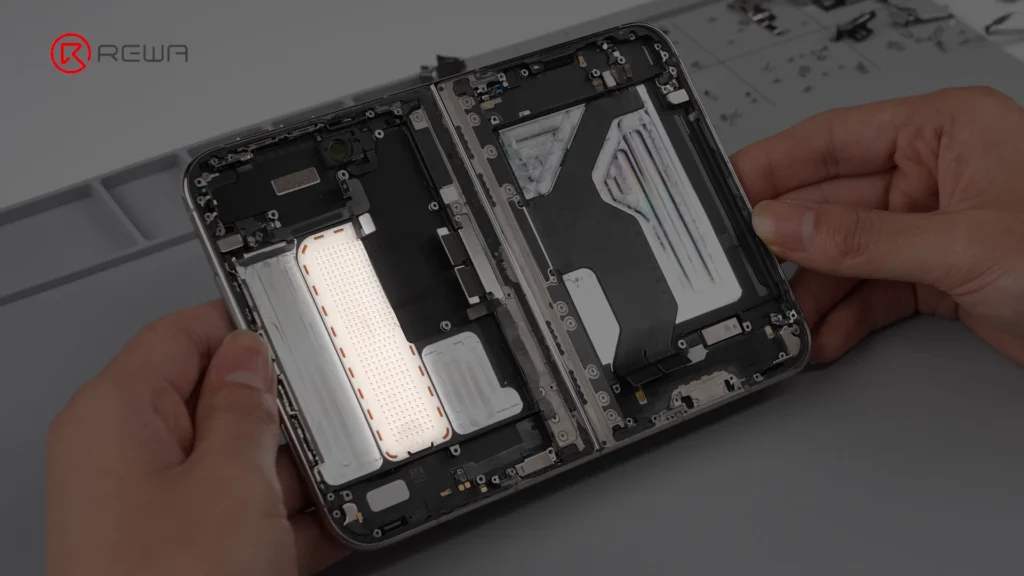
The sub-board also has magnets at all four corners. These magnets can attract screws and screwdriver tips, making nearby screws more difficult to remove or control during disassembly. This is what our technician exactly complains.
Pro Tip: Keep screws organized by their original location and length.
Magnetic components may also affect screw handling, so use controlled tool movements and avoid letting loose screws migrate toward sensitive components.
The Folding Hinge: The Most Mechanically Complex Part?
The hinge is central to the iPhone Duo’s foldable design, and its construction introduces mechanical complexity beyond that of a conventional smartphone.
During the teardown, several factors as follows could make hinge-related repairs particularly demanding:
- Multiple fastening points: Numerous screws and covers must be removed before the hinge can be accessed.
- Adhesive-mounted components: Antenna flex cables and other parts require careful separation.
- Interconnected assemblies: Hinge flex cables link components across the folding structure.
- Mechanical alignment: Reassembly must preserve the correct positioning of the hinge and connected components.
After disassembly, we can see that the hinge itself contains four sets of springs that help hold the display in position as the device folds and unfolds.
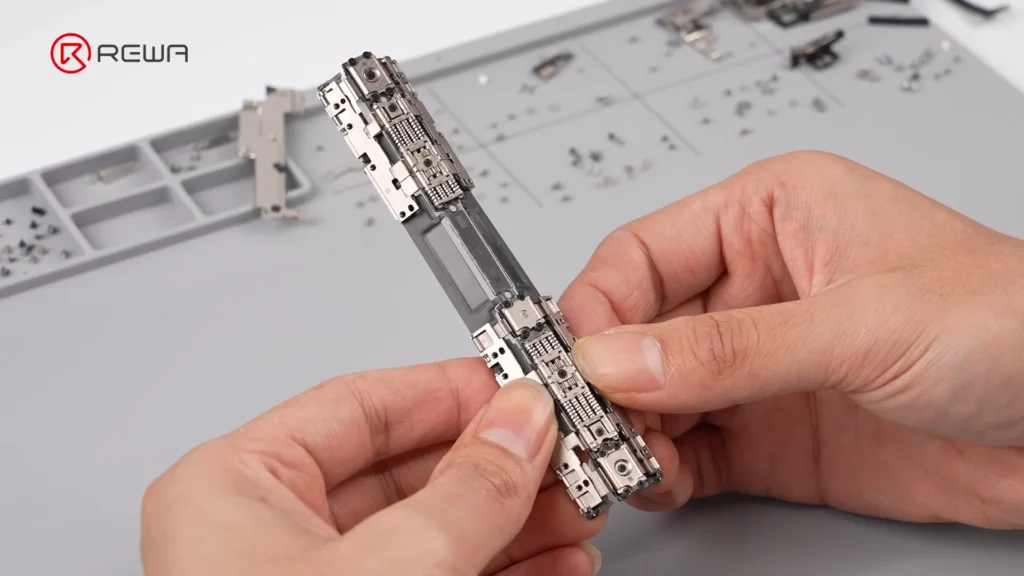
A hinge problem may therefore involve more than replacing one mechanical part. Depending on the failure, technicians may need to inspect the hinge assembly, flex cables, frame, and display condition together.
Is the iPhone Duo Easy to Repair? Key Takeaways for Repair Businesses
The iPhone Duo teardown reveals a mixed repairability picture. Some design choices may simplify specific repairs, while the dual displays, more adhesive, overlapping cables, and mechanical hinge introduce new risks that technicians must account for.
| Composant | Descriptions | Repair Difficulty Level |
| Screen-Outer Display | • Adhesive secured display | ☆ ☆ |
| Screen-Inner Display | • Welded bracket attachment points • Extensive adhesive | ☆ ☆ ☆ ☆ |
| Batterie | • 2 steel-case batteries • Both batteries contain hollow areas | ☆ ☆ |
| Front Camera Module | • Separate front cameras for the inner and outer displays • Outer display’s camera much thinner | ☆ ☆ |
| Rear Camera Module | • Antenna wraps around the rear camera module • Antenna cable overlaps the camera cable | ☆ ☆ ☆ ☆ |
| Carte mère | • No longer sandwich structure • Split into logic board and sub-board connected by FPC | ☆ ☆ ☆ |
For repair stores and refurbishment facilities, the most important lesson is that foldable phone repair requires more than conventional smartphone repair skills. Technicians need a clear understanding of component relationships, adhesive management, flex cable routing, and mechanical assembly.
Frequently Asked Questions(FAQs)
Which component is attached with back cover?
The wireless charging coil cable is connected with back cover. We should pay attention to the cable to prevent from breaking it off during teardown.
What makes iPhone Duo screen replacement difficult?
The outer display has a vulnerable flex cable near its lower-right corner. The inner display is more challenging because it uses a substantial amount of adhesive and a bracket with metal-welded attachment points. Both displays require careful removal to reduce the risk of damage.
Is the iPhone Duo motherboard easier to repair?
Its split logic board and sub-board design may simplify certain repair operations compared with a sandwich-style motherboard. Actual repair difficulty depends on the fault, connector accessibility, component availability, and the work required.
How can we remove the charging port assembly?
We should use a T4 Torx screwdriver and then apply alcohol to soften the adhesive that secures the charging port assembly. In this teardown, we found that the charging port flex cable is much smaller.
Why is the iPhone Duo hinge difficult to repair?
The hinge is connected to multiple flex cables and antenna components and is secured by numerous screws and covers. Its four sets of springs help hold the display in position, making careful disassembly and reassembly essential.
What tools and skills are important for iPhone Duo repair?
Technicians need suitable precision screwdrivers, controlled heating equipment, appropriate opening tools, tweezers, and suitable adhesive-removal supplies. Experience with delicate display removal, flex cable handling, battery safety, and foldable-device structures is also important.
Conclusion: Double Displays, New Repair Challenges
The iPhone Duo demonstrates how foldable smartphone engineering changes the repair process. Its dual-display structure, two-battery layout, overlapping antenna and camera components, and spring-based hinge create additional challenges for disassembly and technical servicing. At the same time, its split motherboard architecture may offer advantages for certain repairs.
For repair professionals, chain repair shops and refurbishment businesses, the takeaway is clear: successful foldable phone repair depends on precise disassembly, careful component handling, and a thorough understanding of the internal structure.
REWA Tech is dedicated to exploring the latest technologies, connecting with top parts and tools suppliers, and providing advanced technical training to the global electronics repair industry. Please feel free to contact us if you need any assistance.


 English
 Español
 Français
 Deutsch
 Italiano